Sunday, February 24, 2019

Anatomy Of The Digestive Tract
Sheep Digestive Track
Mouth: The Mouth, or Oral Cavity, is the place where Mechanical digestion breaks down feedstuffs into smaller units. The Oral Cavity is also known as the Headgut. Prehensile is the first part animals uses, which includes lips and tongue. Then, the sheep will chew or masticate their food into smaller pieces. The digestion starts with a chemical process that occurs through enzymes (salivary amylase) and breakdowns lipids and carbohydrates.

(Sheep Oral Cavity)
Esophagus: The esophagus is a tube that extends from the pharynx to the cardia. When sheep swallow, a flap of cartilage, is compressed to cover the larynx opening and the food moves into the esophagus.

(Esophagus/Digestive)
Stomach:
The Stomach in Sheep are called abomasum. This is where minor mechanical reduction and major chemical digestion occurs. Protein digestion also starts off in the stomach. Gastric lipase acts on lipids. Pepsin breaks down proteins. Hydrochloric Acid activates enzymes that further break down nutrients.
There are four parts to the stomach. The stomach of a ruminant exists as four chambers which are the rumen, reticulum, omasum and abomasum. Sheep digest food more efficiently than hindgut fermenters because they can consume food into the rumen, which allows for microbial digestion, and regurgitation.

(Stomach)
Small Intestine:
This is is the longest section of the gastrointestinal tract. This is the major organ in sheep of digestion and absorption. There are three parts of the small intestine. The Duodenum which is where most digestion takes place. In the Duodenum, acidic food from the stomach mixes with digestive juices from the accessory gland. PH is neutralized in the Duodenum. The Jejunum and the HereIleum are where absorption of nutrients and water occurs. Absorption occurs in the Jejunum and the HereIleum through the villi and microvilli.

(Nutrient Breakdown)
Large Intestine:
This is where remaining material that hasn't been absorbed enters part of the large intestine. Mechanical reduction occurs here. It is a site of water absorption and feces formation/excretion in Sheep. Also microbial fermentation occurs here for monogastrics.
There are four parts of the large intestine including: Cecum, Large Colon, Small Colon, Rectum.
The cecum and colon take in nutrients, water and electrolytes, that are remaining in the digesta after passing through the small intestine.The cecum is a blind sac that arises at the joining of the ileum and colon. According to "Understanding The Ruminant animal Digestive System", the remaining material are excreted as feces from the rectum.
Mouth: The Mouth, or Oral Cavity, is the place where Mechanical digestion breaks down feedstuffs into smaller units. The Oral Cavity is also known as the Headgut. Prehensile is the first part animals uses, which includes lips and tongue. Then, the sheep will chew or masticate their food into smaller pieces. The digestion starts with a chemical process that occurs through enzymes (salivary amylase) and breakdowns lipids and carbohydrates.

(Sheep Oral Cavity)
Esophagus: The esophagus is a tube that extends from the pharynx to the cardia. When sheep swallow, a flap of cartilage, is compressed to cover the larynx opening and the food moves into the esophagus.

(Esophagus/Digestive)
Stomach:
The Stomach in Sheep are called abomasum. This is where minor mechanical reduction and major chemical digestion occurs. Protein digestion also starts off in the stomach. Gastric lipase acts on lipids. Pepsin breaks down proteins. Hydrochloric Acid activates enzymes that further break down nutrients.
There are four parts to the stomach. The stomach of a ruminant exists as four chambers which are the rumen, reticulum, omasum and abomasum. Sheep digest food more efficiently than hindgut fermenters because they can consume food into the rumen, which allows for microbial digestion, and regurgitation.

(Stomach)
Small Intestine:
This is is the longest section of the gastrointestinal tract. This is the major organ in sheep of digestion and absorption. There are three parts of the small intestine. The Duodenum which is where most digestion takes place. In the Duodenum, acidic food from the stomach mixes with digestive juices from the accessory gland. PH is neutralized in the Duodenum. The Jejunum and the HereIleum are where absorption of nutrients and water occurs. Absorption occurs in the Jejunum and the HereIleum through the villi and microvilli.

(Nutrient Breakdown)
Large Intestine:
This is where remaining material that hasn't been absorbed enters part of the large intestine. Mechanical reduction occurs here. It is a site of water absorption and feces formation/excretion in Sheep. Also microbial fermentation occurs here for monogastrics.
There are four parts of the large intestine including: Cecum, Large Colon, Small Colon, Rectum.
The cecum and colon take in nutrients, water and electrolytes, that are remaining in the digesta after passing through the small intestine.The cecum is a blind sac that arises at the joining of the ileum and colon. According to "Understanding The Ruminant animal Digestive System", the remaining material are excreted as feces from the rectum.
Works Cited
“Understanding the Ruminant Animal Digestive System.” Mississippi State University Extension Service, extension.msstate.edu/publications/publications/understanding-the-ruminant-animal-digestive-system.
Digestive Tract Disease
Sheep can ingest the eggs of stomach worms from the grass in which they graze. The larvae, which "are commonly found on wet vegetation, like dewy grass," can travel up the grass to be eaten by the sheep (Aurora). These always-hungry worms will destroy the sheep's stomach lining to access the bloodstream. This can cause the sheep colic, diarrhea, anemia, and weight loss. This can inhibit the sheep's ability to produce milk and is "estimated to cost about $300 million per year in lost production and drench use" with about 40% of the specie affected (Clark). Because worm tests are expensive, group testing is common, but less effective. It is impossible to figure out which of the sheep are infested, so all of them have to be treated. De-wormers can be given to sheep either orally or injected in order to kill the parasites within them. Once treated, they should be separated from the others into an area that can be easily cleaned and retested after 3-4 weeks.
Villarroel, Aurora. "Internal parasites in sheep and goats." Oregon State Extension Servicehttps://catalog.extension.oregonstate.edu/sites/catalog/files/project/pdf/em9055.pdf (2013).
 |
| Evidence of parasite infestation, which includes loss of stomach lining and diarrhea (pictured above) |
Works Cited
Gary Clark, Neville Grace and Ken Drew, 'Diseases of sheep, cattle and deer - Sheep contagious diseases', Te Ara - the Encyclopedia of New Zealand, http://www.TeAra.govt.nz/en/diagram/17431/internal-parasites-of-sheep (accessed 25 February 2019)Villarroel, Aurora. "Internal parasites in sheep and goats." Oregon State Extension Servicehttps://catalog.extension.oregonstate.edu/sites/catalog/files/project/pdf/em9055.pdf (2013).
Friday, February 22, 2019
Feeding and Eating Habits
A sheep’s diet consists mainly of: grass, clover (other legumes), forbs and other pasture plants native to the area in which the sheep lives. Sheeps enjoy eating forbs (broad leaf plants, not grass), and often favor these rugged plants over grass. In addition, sheep are known as picky eaters (as compared to other grazers, i.e. cattle). The amount of attention/nutrition your sheep requires is typically determined by their role on the farm. For example, pregnant sheep/nursing ewes require more nutrition, as compared to ewes not raising lambs (only producing wool) require less. It is also important to note that, “the single most important thing that sheep consume is fresh, clean water and it’s critical that your sheep have constant access to water so that they can be healthy, happy and thrive” (raisingsheep.net). As for the specific production practices, it is essential to ensure that the fresh water is provided, adequate roughage (hay, silage and pasture is present), and other neccessary steps to follow: “1. Crop feed of 20% protein is reccomended, 2. Start lambs on crop feed at 10 to 14 days of age, 3. Secure your hay source & line up the source early in the season, 3. Test the nutritional content with a forage test in order to balance the ration and save on grain purchases” (mofga.org).
Works Cited
“Publications.” Maine Organic Farmers and Gardeners Association, www.mofga.org/Publications/The-Maine-Organic-Farmer-Gardener/Summer-2013/Sheep.
RaisingSheep.net. “What Do Sheep Eat? Sheep Food & Pasture.” Raising Sheep, www.raisingsheep.net/what-do-sheep-eat.html.
Thursday, February 21, 2019
Body Condition Scoring
The Department of Primary Industries and Regional Development states that sheep are scored in terms of their muscle mass and fat cover. On sheep, body condition scores are obtained by placing a hand on the sheep's backbone and short rib, the space between the long ribs and the hips. The scorer evaluates the cover of fat and tissue on the backbone and at the ends of the short ribs, they also assess the overall muscle condition ("Condition Scoring of Sheep). Below is the general chart used to determine the condition score, 2-3 is the preferred score for market wethers and breeding ewes.
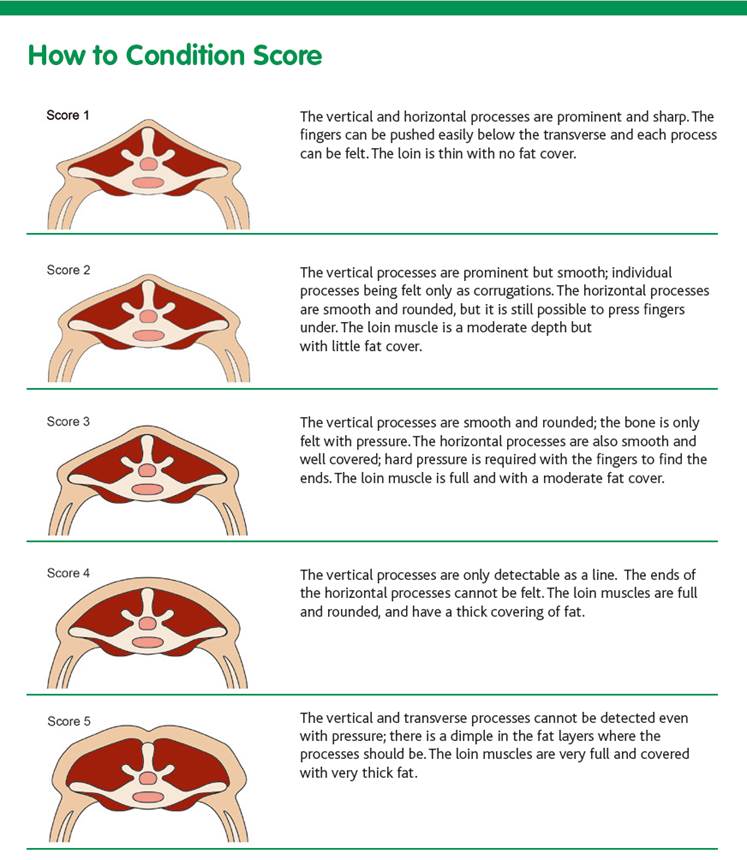 |
| Grading Scale for Sheep Body Condition |
Works Cited
"Condition Scoring of Sheep | Agriculture and Food." Agriculture and Food Department of Primary Industries and Regional Development, 11 Oct. 2018, www.agric.wa.gov.au/management- reproduction/condition-scoring-sheep.
Thursday, February 14, 2019
Anatomical Classification:
This is a type of fermentation that occurs in the rumen of ruminant animals. Ruminant animals have four compartments in their stomach instead of one. Of the four compartments is called the rumen, which is the largest and main section. According to "Range Animal Nutrition", "By comparison the food consumed by ruminants is subjected to microbial fermentation.” Pre-gastric fermentation occurs before feed goes into the digestive tract where digestion typically occurs. Fermentation takes place before the majority of the digestion process. During Pre-gastric Fermentation, fermentation through microbes occurs in the rumen, all before moving to the abomasum. An example of a ruminant stomach is displayed below.

(Ruminant Stomach)
Works Cited
Satapati, Suresh. Frankenstein, www.webpages.uidaho.edu/range456/readings/heitschmidt_stuth_book/chapter_2/chapter2_animals.htm.
Tuesday, February 12, 2019

Sheep Eating Grass
If you look closely, you can see the sheep using their cleft upper-lip to closely
graze the grass.
Nutritional Ecology Classification of Sheep
- According to Sheep 101, sheep are continuous feeders that graze on grass, hay and other low-quality foodstuffs.
- They are herbivores, which means that they enjoy a diet of all plant materials (Sheep 101).
- In the picture below sheep are seen grazing in a pasture proving that they are both continuous feeders and herbivores.
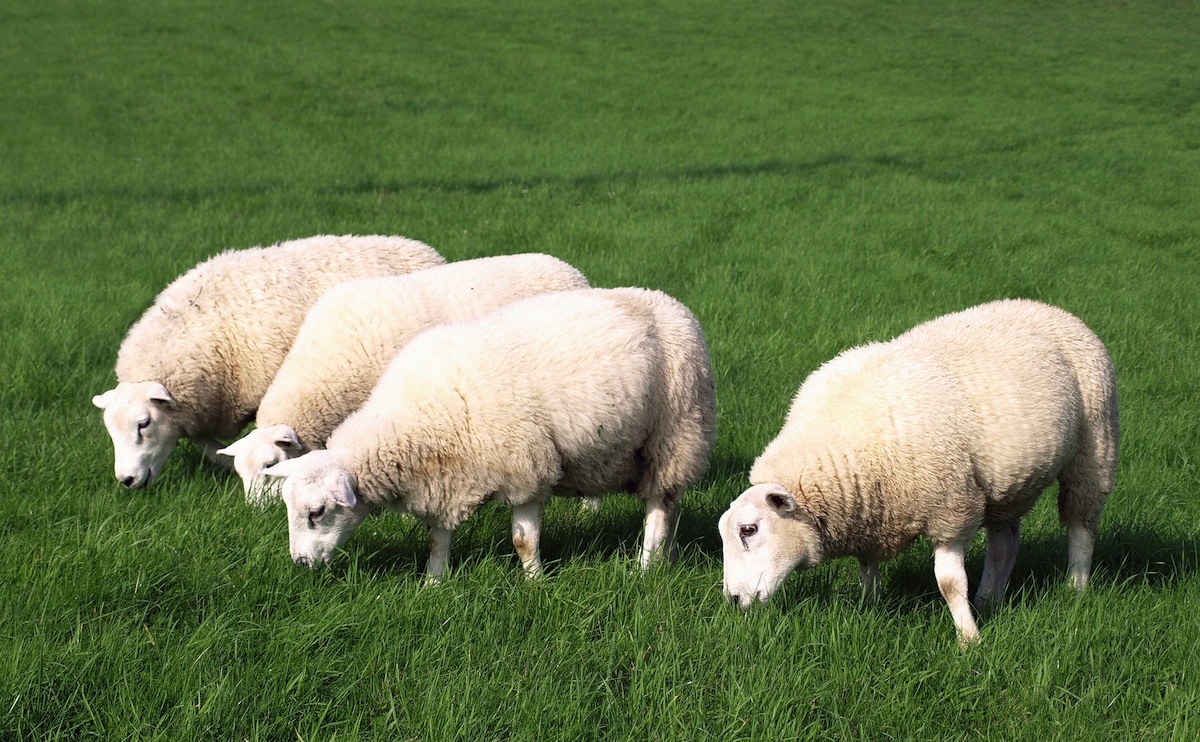 |
| Sheep Grazing in a Pasture |
Works Cited
"Sheep 101: Sheep and Goats." Sheep 101 Home Page, Sept. 2015,
www.sheep101.info/sheepandgoats.html.
Digestive Anatomy:
Harvesting Equipment-
- A lamb is born with eight milk teeth at the front; a pair of milk teeth is replaced each year starting with the pair in the middle
- By the time the sheep is fourth years old, said to be full-mouthed
- The condition of molars- if they become rough, broken and prevent sheep from eating properly, the animal needs to be culled
Mouth-
- Cleft upper lip allows sheep to closely graze
- Their small mouthparts/narrow muzzle allow them to be selective of their plant species
- Grass dominated diet
Digestive Tract-
- Sheep are ruminants, meaning they have a four chambered stomach consisting of rumen, reticulum, omasum and abomasum
- They eat a large amount of vegetation that is first softened and broken down in the rumen by microbes (mostly consisting of bacteria)
- After, they regurgitate the semi-digested plant matter (also known as chew called "chewing the cud), and they swallow it back again
- Regurgitation and fermentation process extract nutrients (one of which is cellulose), from plant materials
- The photo below depicts the Sheep's digestive tract with arrows pointing out the process: from when it first enters in the Esophagus all the way until the Sheep defecates it out.
 |
| Diagram of Sheep's Digestive Track |
Works Cited
http://citadel.sjfc.edu/students/naa07113/e-port/Herbivores.html
https://anrcatalog.ucanr.edu/pdf/8524.pdf
https://toaaps.weebly.com/ruminant-digestive-system.html
Subscribe to:
Comments (Atom)